

Will this app shut down? Six questions to ask before you trust a tool
2026 has been a busy year for the software undertaker, so the pig has put flowers on a few floppy disks and written down what the departed had in common.
Every year some apps people rely on simply stop, and this year the shelf of little tombstones filled up quickly. Workplace from Meta closed for good on 31 May 2026 and took its data export with it, after a slow fade that began with a read-only mode the previous September. TV Time stopped after 15 July 2026, an app TechCrunch says had more than 26 million lifetime installs, with personal data deleted once the lights went out. Notion switched off the inbox of Notion Mail on 22 September, according to a BigGo Finance report citing Notion's own posts, and remove.bg closes its standalone website on 1 December and moves into Canva, which we have written about in a roundup of remove.bg alternatives. None of these were bad products, and plenty of people loved them, which is exactly why it stings.
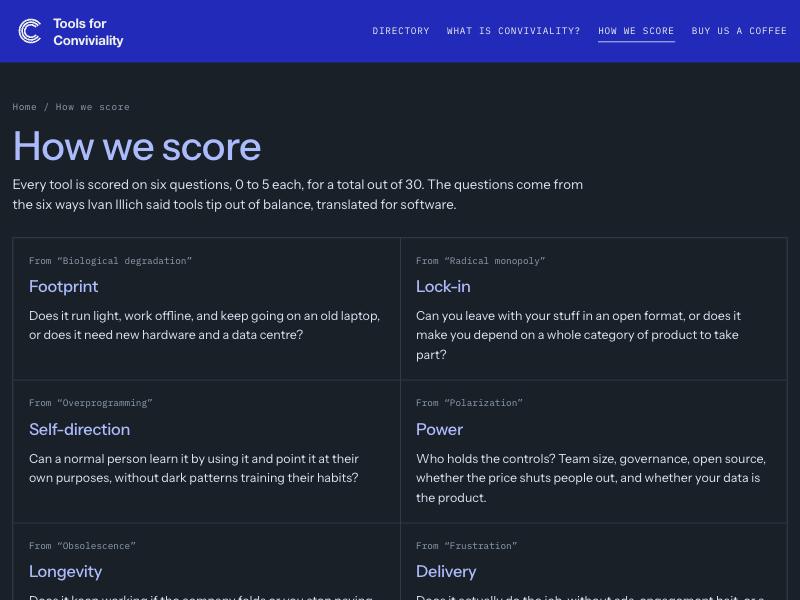
You cannot tell for sure which tool will be next, but you can tell which ones will hurt less when they go. In 1973 the philosopher Ivan Illich wrote a short book called Tools for Conviviality about tools that serve the people using them instead of the other way round, and its warnings translate surprisingly well from factories and highways to apps. Here they are as six questions, the kind you can ask about any tool in about the time it takes to brew a coffee.
Can you leave with your stuff?
This is the question to ask first, because it decides whether a closure is an inconvenience or a loss. A good tool lets you export everything, any day, in a format another program can open, such as plain text, CSV, standard image files or an open document format. A worrying one offers an export only when it is already packing its bags, or offers one that only it can read. Illich called the extreme version radical monopoly, where you cannot take part at all without one particular kind of product, which is a grand name for the feeling of being unable to leave a group chat.
Does it work without the company?
A tool that keeps running on your own computer when the company folds, or when you stop paying, has a very different death from one that lives entirely on someone else's servers. Apps that store files on your device, work offline, or can be hosted by anyone keep working long after their makers lose interest. Software that switches off the moment a server does is renting you your own work, and the lease has a clause you did not read.
Who holds the controls?
Look at who owns the tool, how big the team is, whether the code is open and how it makes money. A small team funded by its users answers to its users, and an open source project can carry on even if the original makers walk away, because somebody else can pick it up. When a product is free and nobody can explain how it pays for itself, it is worth wondering who the customer is, since TV Time's owners said it had become unsustainable to run for free.
Does it run on what you already own?
Tools that run light keep working on an old laptop, a tired phone or a slow connection, and they tend to survive because they cost little to keep alive. Tools that need the newest device and a data centre to do something simple are expensive to run, and expensive things are the first to be cut when a company changes its mind about what it wants to be.
Can you make it yours?
A good tool can be learned by using it and pointed at your own purposes, with settings and files you understand. A tool that trains your habits with streaks, nudges and dark patterns is shaping you more than you are shaping it, and when it disappears you lose the habits along with the app, which is a strange kind of withdrawal.
Does it just do the job?
The last question is the simplest one: does the tool do what it says, without ads, engagement bait or promises it cannot keep? A tool that is honest about what it does is usually honest about how it is doing, which makes it more likely to warn you early, keep its export button working and leave the porch light on while you move out.
A directory that asks these questions
If you would rather not ask them all yourself, Tools for Conviviality is a directory of small, independent software where every tool is scored from 0 to 5 on each of the six questions, for a total out of 30. The questions are footprint, lock-in, self-direction, power, longevity and delivery, and the scoring page explains how each one comes from one of the ways Illich said tools tip out of balance. Scores of 25 and up are called convivial, 18 to 24 leaning convivial, 10 to 17 mixed and anything lower restrictive, and each review is dated, because tools change and so do we.
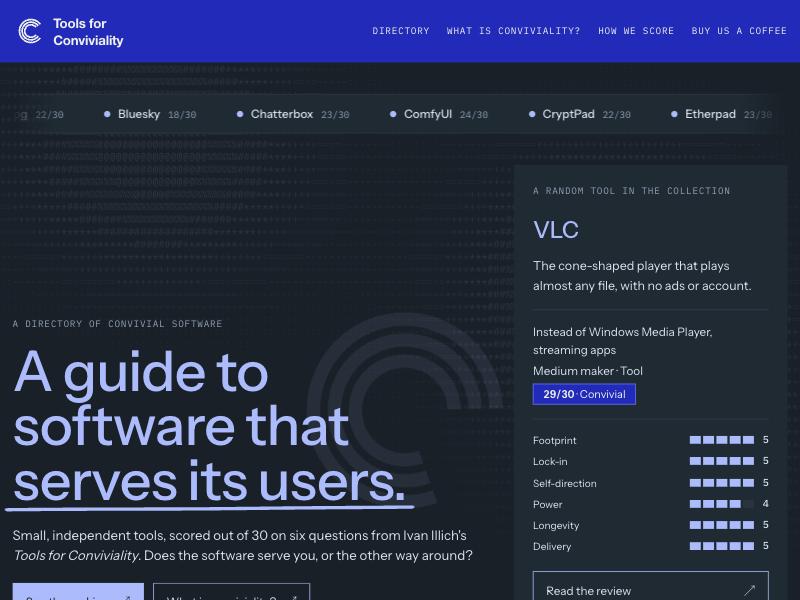
At the top of the leaderboard you will find the likes of LocalSend and VLC at 29, Zotero at 28, and a long list of everyday swaps, grouped by the big product they replace. If you are worried about your documents there are LibreOffice and Etherpad, if you send newsletters there are listmonk and Buttondown, and if you are tired of video calls belonging to one company there is Jitsi Meet. An AI model drafts each review from the tool's public pages, code and policies, and a person checks every review before it goes up, so the scores are a well-read opinion and not a laboratory result. If a score looks wrong, the site has a form for telling it so, and makers in the directory can show a badge for their review without paying a cent.
What to do this week
Pick the three tools you would miss most, ask each of them the first two questions, and try their export buttons today rather than on the day of the funeral. If one of them fails both questions, have a look at the directory for something that would be easier to leave, and if it passes, you can go back to work with a lighter heart. The pig did this exercise with great seriousness, from his bed, and found that his most important tool is a pillow, which scores very well on footprint and has never once shown him an ad.
Questions people ask
How can I tell if an app is likely to shut down?
Nobody can promise a tool will last, but six questions help: can you leave with your data in an open format, does it work without the company's servers, who controls it and how it makes money, does it run on the hardware you have, can you shape it to your own work, and does it do its job without ads or engagement tricks. A tool that scores well on these hurts less if it does close.
What happens to my data when an app shuts down?
It depends on the app. TV Time offered a data export before it stopped on 15 July 2026 and said personal data would be deleted, and Workplace from Meta stopped offering data exports when it closed on 31 May 2026. Export your data as soon as a closure is announced, and prefer tools that let you export it any day of the week.
What is a convivial tool?
The idea comes from Ivan Illich's 1973 book Tools for Conviviality: a convivial tool serves the person using it, can be learned by doing and shaped to their own purposes, and does not make them depend on a company or a whole category of product.
A note from the part of the company that is awake: Tools for Conviviality is run by the same person who runs Pigrosoft. The closure dates come from the sources linked above: Wikipedia for Workplace, TechCrunch for TV Time, a BigGo Finance report for Notion Mail and remove.bg's own FAQ for remove.bg. The scores quoted are the directory's as they stood when we wrote this, and they are dated and can change.